Mosquito-Free Living Insights
What Affects a Bug Zapper's Effective Coverage Area?
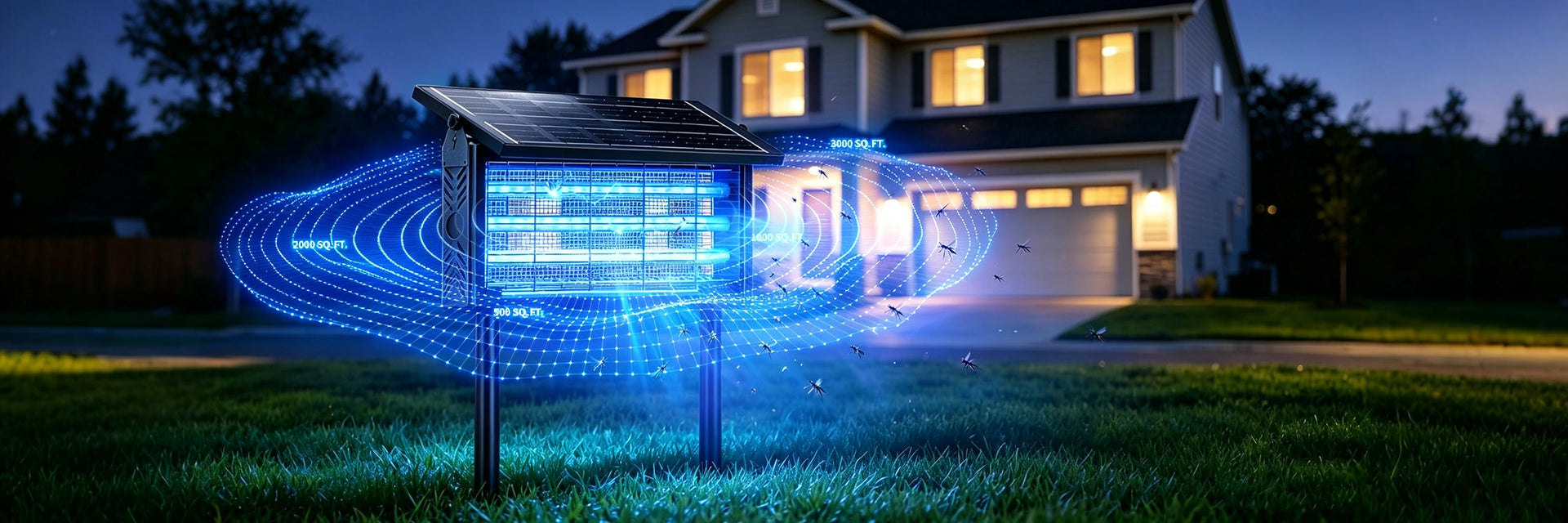
Search "bug zapper coverage area" and most results come back with a single number — half an acre, 4,000 square feet, and so on. Those figures come from controlled testing conditions, and real backyards rarely match them exactly. A more useful question is what actually changes how far a zapper's coverage reaches in a specific space, since the same unit can perform differently depending on where and how it's set up.
The Core Mechanics: Grid and Light
A bug zapper like the Murutoi G8 relies on two things working together — a UV LED light source to attract insects, and a 2500V high-voltage grid to handle them once they're close. The grid itself is a fixed, defined size, but the attraction radius depends heavily on how visible that UV light is from a distance. That visibility is where most of the real-world variation comes from.
Factor 1: Obstructions Between the Unit and the Space
Anything solid between the zapper and the area it's meant to cover — a fence panel, a row of tall shrubs, a parked car, an outdoor structure — can block the UV light's visibility from that side. A unit tucked behind a planter or against a wall effectively loses coverage on the blocked side, even if the open side performs exactly as expected.
Factor 2: Competing Light Sources
UV light has to stand out to attract insects effectively. Porch lights, string lights, a neighbor's floodlight, or even a bright kitchen window nearby can pull insect attention away from the zapper, especially the closer and brighter that competing source is. This is one of the most common reasons a zapper seems to underperform in real use — it isn't a lack of range, it's competition for attention.
Factor 3: Mounting Height and Position
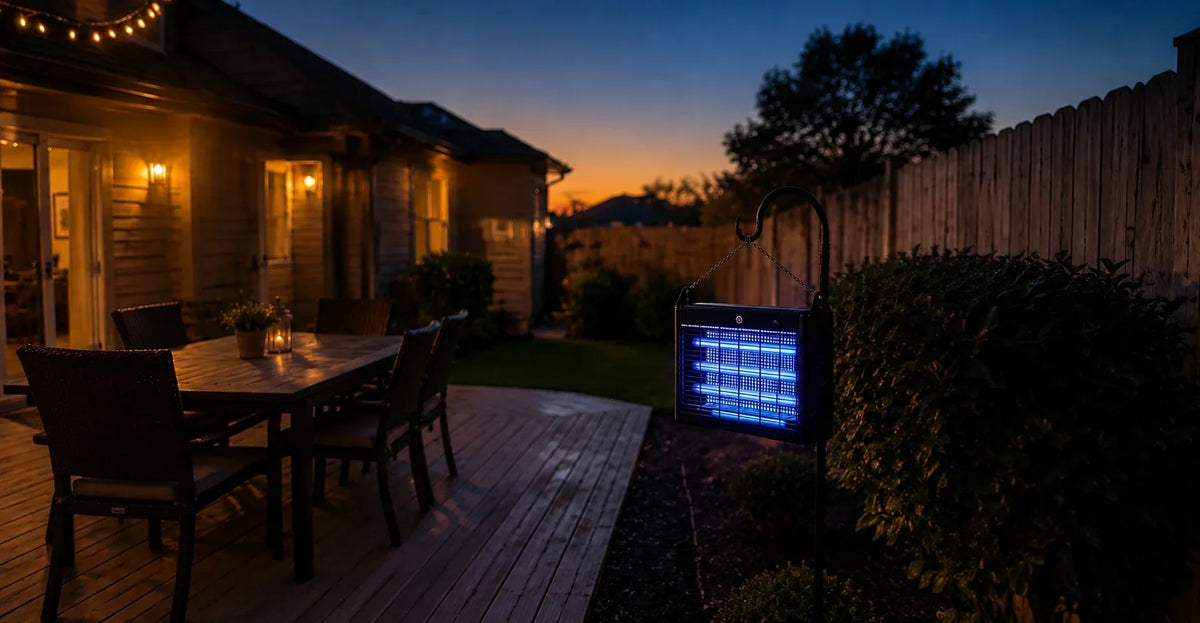
Where the unit sits relative to typical insect flight paths matters. Mounted too low and tucked near the ground, or too high and away from where people actually gather, the effective working range shifts even if the stated coverage number stays the same. Positioning at a height roughly in line with where mosquitoes are actively flying — rather than as high or as low as possible — tends to make better use of the unit's range.
Factor 4: Yard Layout and Shape
A perfectly open, flat, circular yard rarely exists. Most outdoor spaces are irregular — an L-shaped patio, a yard split by a fence line, a deck that wraps around a corner of the house. Coverage radius assumes an open, unobstructed circle around the unit, so an irregularly shaped space may need the zapper positioned closer to the section you actually use rather than in the geometric center of the property.
Factor 5: Distance From the Activity Zone
A zapper covering "the yard" in general and a zapper covering "the dinner table" specifically aren't quite the same task. Positioning the unit closer to where people are sitting, rather than at the far edge of the property, generally does more for the experience that matters — even if it means a lower theoretical coverage number toward less-used areas of the space.
For Larger Spaces: Multiple Units
For yards on the larger end, or properties with distinct zones — a patio, a side yard, a detached garden area — a single zapper positioned at one end may not meaningfully reach the far side, regardless of its rated range. Rather than relying on one unit to stretch across a whole property, positioning a zapper near each zone people actually use tends to give a more consistent result across the full space.
The Takeaway
A bug zapper's coverage isn't a single fixed number that applies everywhere — it's a starting point that shifts based on obstructions, competing light, mounting position, and the shape of the space it's working in. Rather than asking "how many square feet does this cover," it's usually more useful to ask "what's between this unit and the space I want covered" — since that's what actually determines how well it performs where it counts.