Mosquito-Free Living Insights
Where to Place Your Solar Bug Zapper for the Best Results
A solar bug zapper only works as well as where you put it. The unit itself does the work through a simple three-step process — attract, zap, protect — but placement is what determines whether that process actually happens near your patio table or somewhere you never notice. Here's how the Murutoi Solar Bug Zapper's process works, and how to think about where to set it up.
The Three-Step Process, Explained
1. Attract The zapper uses dual 365–395 nm UV LEDs to draw mosquitoes and other flying pests toward the unit. This dual-wavelength approach is the foundation of the whole system — if mosquitoes aren't drawn in, nothing downstream matters.
2. Zap Once pests are drawn close, a 2500V high-voltage grid handles the rest — quickly and without any chemicals or sprays involved.
3. Protect The unit is solar-powered and rated IPX5 for water resistance, so it's built to keep running outdoors, night after night, without needing to be brought inside or manually restarted.
Understanding this sequence matters because placement decisions should support each step, not work against it.
Where Placement Actually Matters
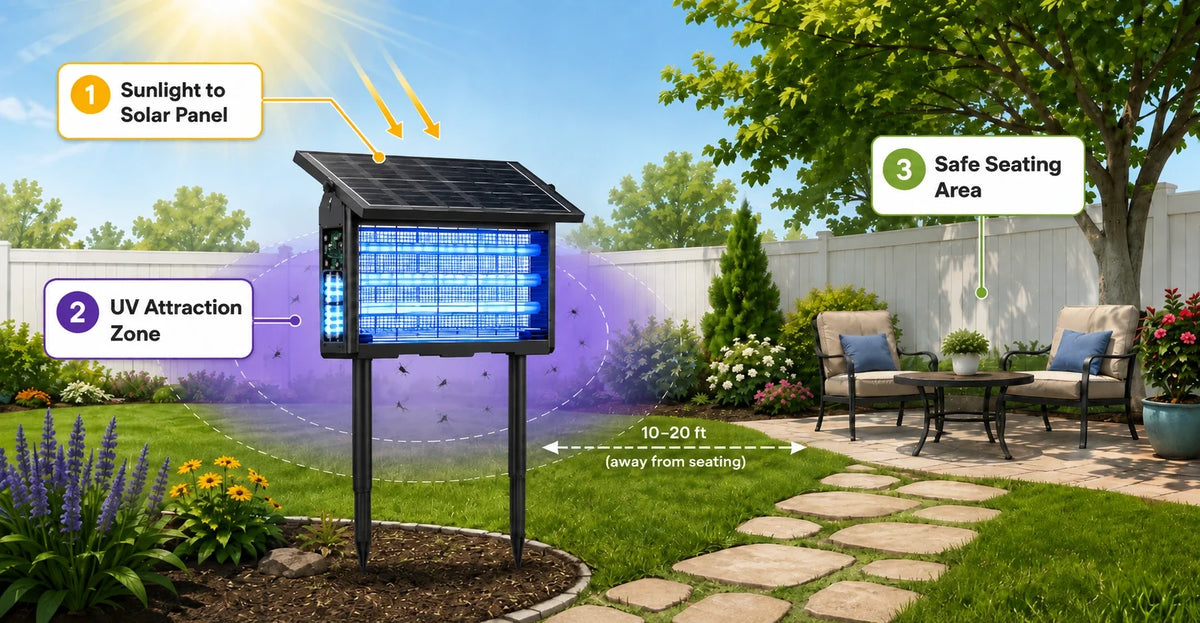
Give the solar panel real sun exposure. Since the unit runs on solar power, its placement needs to prioritize sunlight during the day, not just convenience at night. A spot that looks ideal for evening use but sits in shade all afternoon will undercharge the unit over time.
Put distance between the zapper and where people sit. The UV LEDs are designed to pull mosquitoes toward the unit — which means you want that pull working away from your seating area, not competing with your porch light or string lights in the same spot. Positioning the zapper a reasonable distance from where people actually gather lets the "attract" step do its job without drawing mosquitoes closer to your guests first.
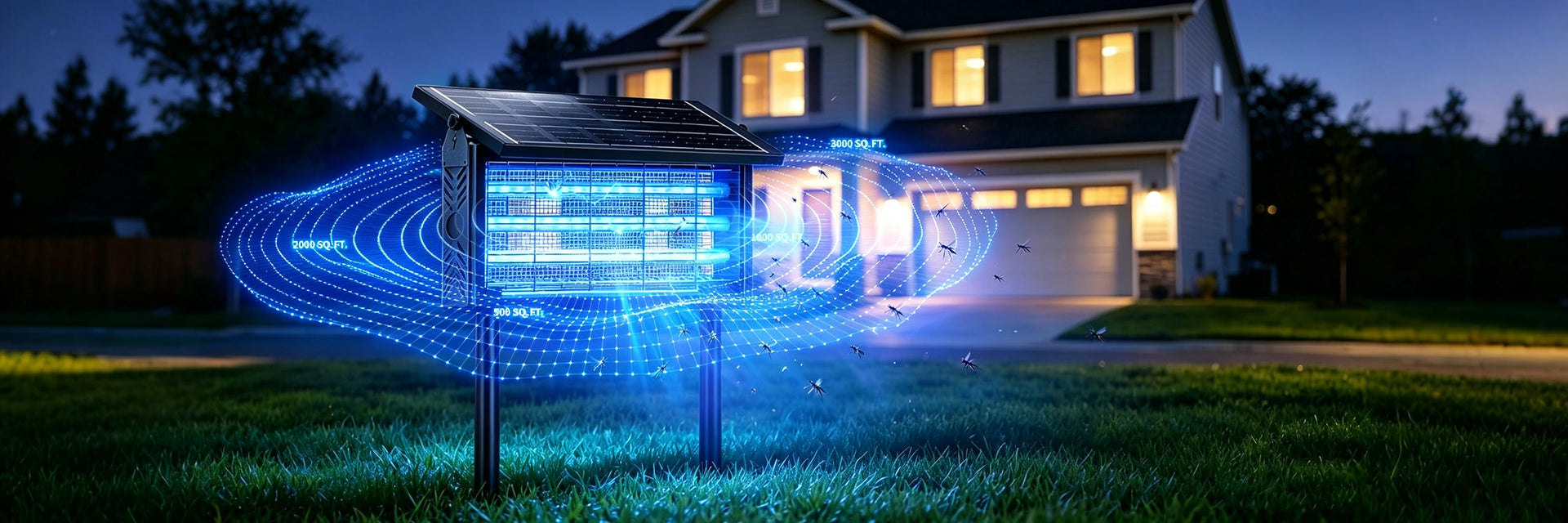
Consider your yard's specific layout. A small patio and a large backyard call for different placement thinking. Murutoi's Solar Bug Zapper comes in small and large sizes, so matching the unit size to your space is part of getting the placement right in the first place.
Keep the charging port accessible. The unit charges via a DC round-pin connector. If you ever need a manual top-up after a stretch of cloudy days, a placement that's easy to reach — rather than tucked into hard-to-access landscaping — makes that simple instead of a hassle.
Weather resistance means you don't have to overthink relocation. Because it's IPX5-rated, you don't need to move the unit indoors for rain. The main placement consideration is sunlight and distance from seating, not weather protection.
A Simple Way to Think About It
If you picture the three-step process as attract → zap → protect, placement is really about optimizing for the first step (sunlight for charging, clear line of sight for attraction) while keeping the second step (the zap itself) at a comfortable distance from people. The third step — solar power and IPX5 durability — is what lets you set it and leave it once placement is right.
Bottom Line
The technology inside the Murutoi Solar Bug Zapper — dual UV LEDs, a 2500V grid, solar charging, and IPX5 durability — is designed to run largely on its own. The one variable that's entirely in your hands is where you put it. A few minutes thinking through sun exposure, distance from seating, and yard size pays off in how well the whole system performs.