Mosquito-Free Living Insights
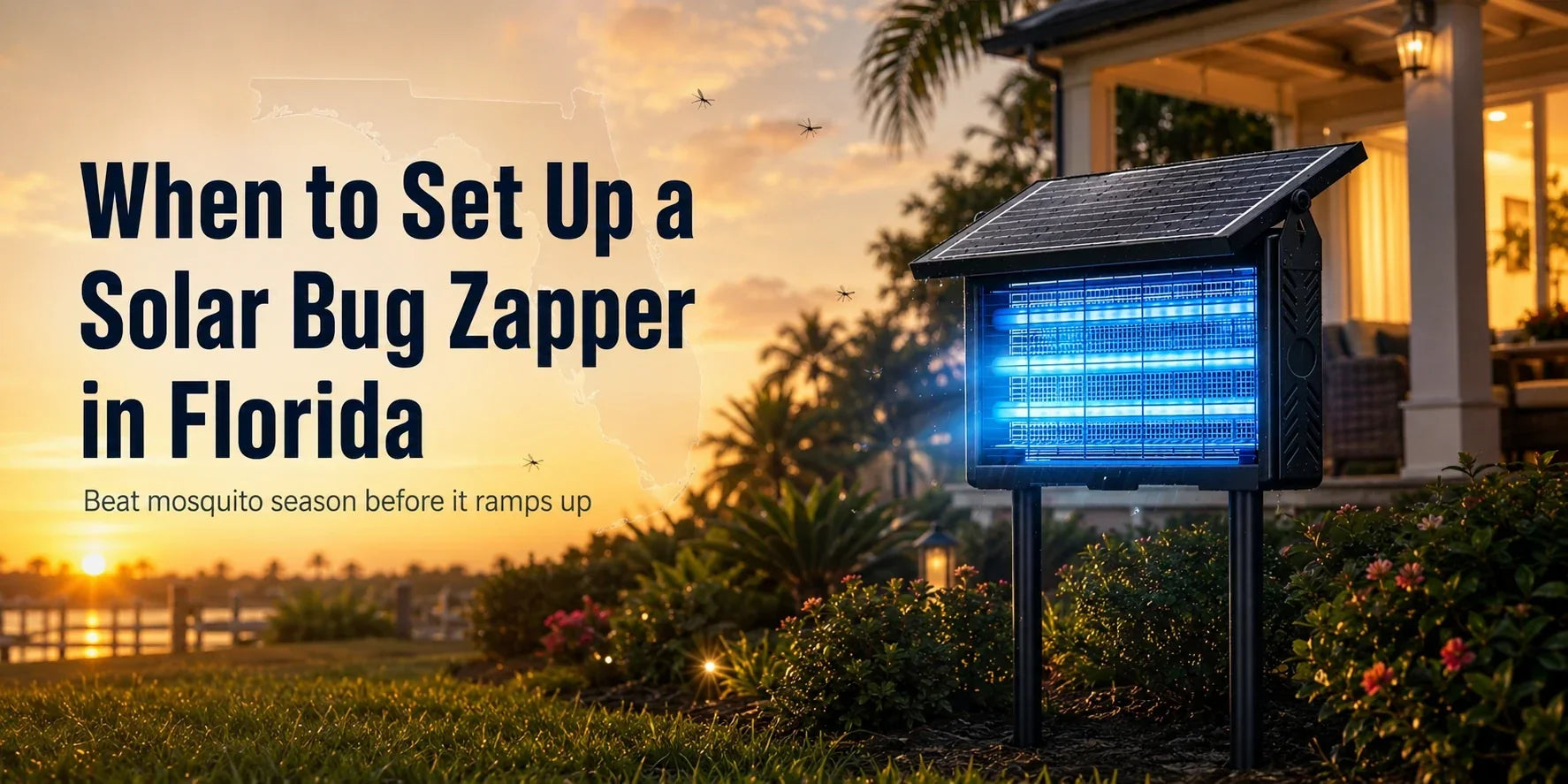
Florida Mosquito Season Guide: When Zapper Setup Matters Most
Most of Florida doesn't have a true "off" mosquito season. Entomologists generally note that mosquito activity picks up once temperatures stay consistently above about 50°F, which in Florida can happen as early as February in some areas. South Florida tends to see activity nearly year-round; Central and North Florida usually see more of a winter lull. Setting up a solar zapper before your region's spring ramp-up, rather than waiting until mosquitoes are already noticeable, is the general best practice.
If you live in Florida, you already know mosquitoes aren't just a "summer problem." Between the humidity, standing water, and mild winters, much of the state rarely gets cold enough for long enough to fully knock back mosquito populations. That makes timing your outdoor defenses — including when you set up a solar bug zapper — worth planning around, more so than in cooler climates.
Why Florida's Mosquito Season Runs Longer
In much of the U.S., mosquito season is roughly bookended by the first and last frost. Florida rarely gets that. According to agricultural extension and pest-control sources, mosquitoes generally become active once temperatures hold above ~50°F, and depending on species, eggs can hatch anywhere from about 24 hours to a week or more under favorable conditions. In practice, this means Florida's mosquito season tends to run noticeably longer than the national average — though exact timing varies by year, rainfall, and region, so treat any specific dates as general guidance rather than a fixed calendar.
Florida Mosquito Season by Region (General Patterns)
South Florida (Miami, Fort Lauderdale, the Keys) Tends to see mosquito activity nearly year-round, with peak pressure typically during the summer rainy season (roughly June–October).
Gulf Coast (Tampa, Naples, Sarasota) Similar pattern to South Florida, usually with a bit more seasonal variation — activity often builds starting in the spring and eases somewhat in winter.
Central Florida (Orlando, Lakeland) Generally follows a March-through-November pattern, with the heaviest activity typically in the June–September rainy season.
North Florida (Jacksonville, Tallahassee) Usually the closest to a "traditional" mosquito season among Florida's regions, with a more noticeable winter lull, though activity can still start earlier than in most other U.S. states.
Note: these are general regional patterns commonly cited by pest-control and extension resources, not guarantees for any specific year or location — local weather (rainfall, cold snaps, drought) can shift timing meaningfully.
General Guidance on Zapper Setup Timing
Because Florida's season tends to start earlier and run longer than much of the country, a common mistake is waiting until peak summer to set up outdoor defenses — by the time activity is very noticeable, populations have typically already been building for weeks.
As general guidelines (not hard rules):
- South Florida & Keys: Many residents find it worthwhile to keep a solar zapper set up year-round, given the shorter or less predictable winter lull.
- Gulf Coast & Central Florida: Setting up by early-to-mid March, ahead of the typical spring increase, is a reasonable target for many households.
- North Florida: Late February to early March is a commonly suggested setup window, ahead of the spring warm-up.
Setup Tips for Florida's Climate
Florida's combination of strong sun and heavy seasonal rainfall generally suits solar-powered units well, but placement still matters:
- Keep the zapper out of direct hose or sprinkler spray, even for units rated for outdoor weather exposure.
- Afternoon thunderstorms are common in summer — a mounting spot with some overhead cover or a stable base can help reduce wind exposure.
- Look for a spot with strong sun exposure for most of the day to support consistent solar charging.
Florida doesn't really have an "off" mosquito season so much as lower-activity and higher-activity stretches, and the exact timing shifts from year to year. Setting up your solar bug zapper ahead of your region's typical ramp-up — rather than reacting once mosquitoes are already noticeable — is a reasonable, commonly recommended approach for getting more out of the season ahead.