
Mosquito-Free Living Insights
How to Clean and Maintain Your Solar Bug Zapper for Peak Performance
A solar bug zapper works hardest during peak mosquito season, and that means it also collects the most debris. A build-up of dead insects on the grid or dust on the solar panel doesn't just look unpleasant — it can quietly reduce how well your zapper attracts bugs and how efficiently it charges. The good news: keeping your Murutoi G8 (2 UV tubes) or G8L (3 UV tubes) in top shape takes just a few minutes every couple of weeks, with no disassembly required.
Why Cleaning Matters
The UV tubes are what draw insects in, and the high-voltage grid (2500V on both models) is what does the work. When the grid is coated in dead bugs, wing dust, and residue, its attraction power drops and the light output can look dimmer. On the solar side, a dusty panel absorbs less sunlight, which means a weaker charge and shorter run time after dark.
Cleaning the Grid
- Always unplug or fully power down the unit before touching the grid.
- Wait a few minutes after powering off to be sure any residual charge has dissipated.
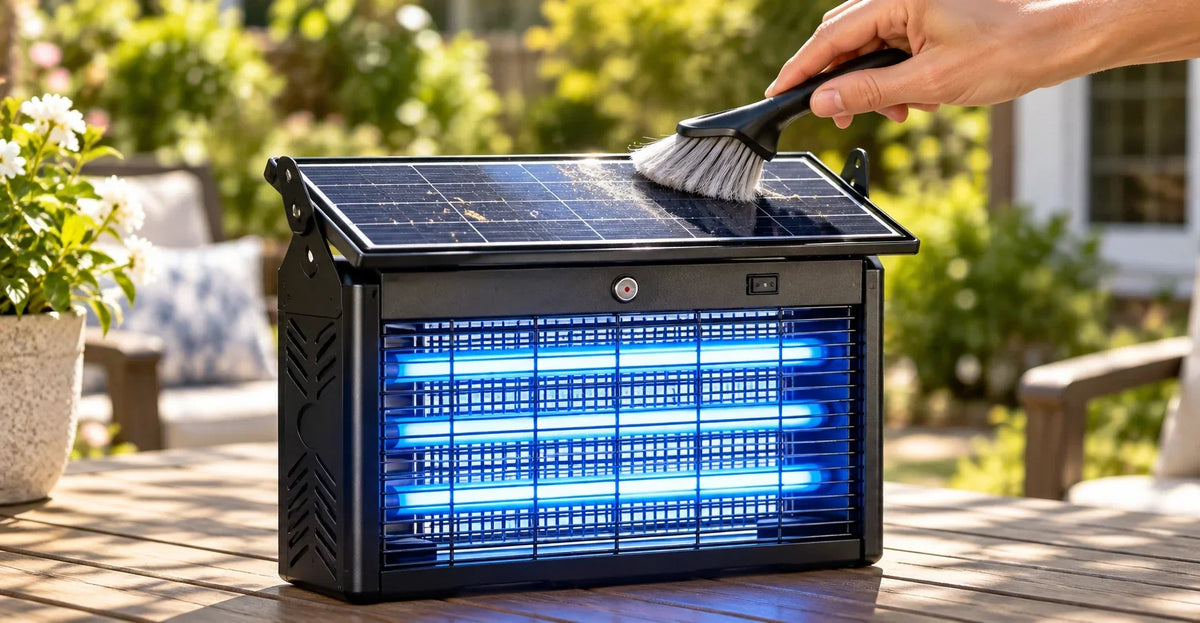
- Use a soft-bristled brush (not included — any small, dry paintbrush or dedicated bug-zapper brush works) to gently sweep debris off the grid wires.
- For stubborn residue, a slightly damp cloth works — never spray liquid directly onto the grid or electronics.
- Let everything air-dry fully before powering the unit back on.
Clearing Fallen Debris
The G8 and G8L don't have a removable collection tray — dead insects simply fall away from the unit as it operates. During peak season, it's worth a quick check of the ground or surface directly beneath the zapper every week or so, and clearing away any buildup so it doesn't attract ants or other pests.
Caring for the Solar Panel
The solar panel is what keeps your zapper running without cords or batteries to swap, so it deserves attention too:
- Wipe the panel with a soft, dry cloth to remove dust, pollen, and water spots.
- Avoid abrasive cleaners or scrubbing pads, which can scratch the surface and reduce absorption over time.
- Check for shade creep — nearby branches or growing plants can block sunlight without you noticing.
- Good news for cleaning day: the water-resistant design means you can safely hose down the whole unit for a deeper clean when needed.
A Simple Maintenance Rhythm
- Weekly (during active season): Check for debris underneath, quick wipe of the panel.
- Every 2–3 weeks: Full grid cleaning with a soft brush.
- End of season: A deep clean before storage — see our winter storage guide for the full process.
A little routine care goes a long way. Five minutes with a brush and a cloth keeps your solar bug zapper attracting more bugs and charging more efficiently all season long.