Mosquito-Free Living Insights
Solar Bug Zapper Not Turning On? Common Fixes to Try First
If your solar bug zapper isn't lighting up at dusk, the cause is usually something simple — not a defective unit. Here's what to check first.
1. Check the solar panel's sun exposure
Insufficient daytime charging is the most common cause. If the unit's been in partial shade or it's been an unusually overcast stretch, the battery may not have built up enough charge. Your zapper includes a 20-ft solar extension cable, so you can move just the panel to a sunnier spot without relocating the whole unit.
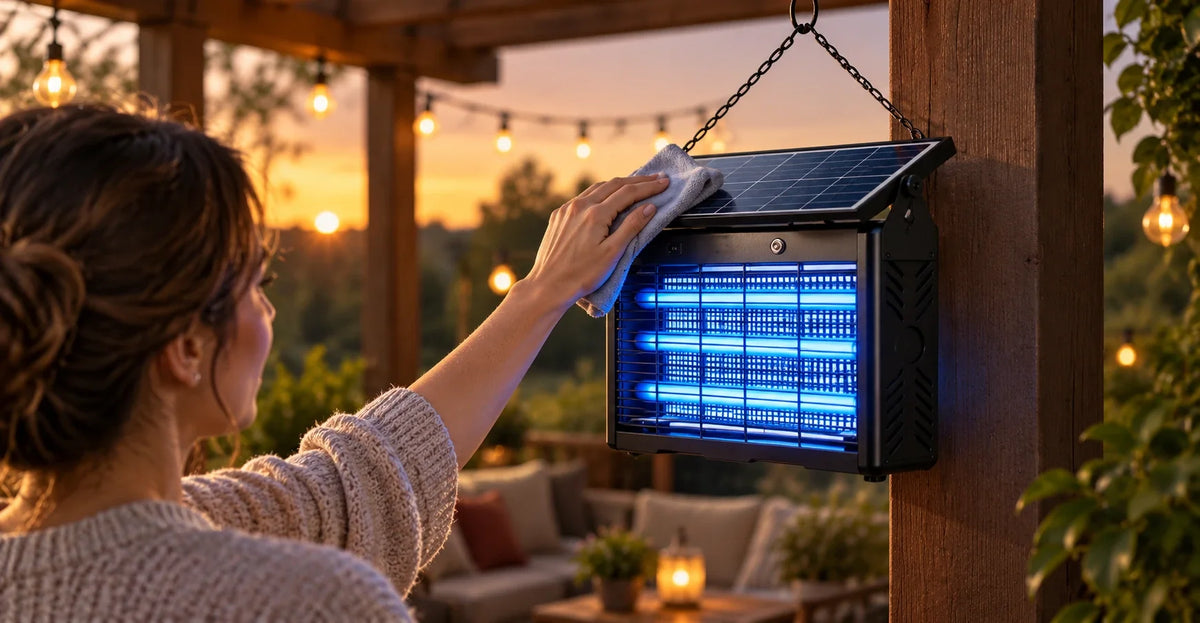
2. Wipe down the solar panel
Dust or pollen buildup on the panel surface reduces how much sunlight it absorbs. A quick wipe with a soft, dry cloth keeps it charging efficiently.
3. Confirm the charging cable connection
If you're using the included USB (DC round plug) cable as backup power, make sure it's fully seated. Only use the cable that came with your unit — it's a round-pin connector, not USB-C, so a mismatched cable won't charge it. On cloudy days, a full charge via this cable takes about 3–4 hours.
4. Check that the auto sensor isn't confused by nearby light
The zapper uses a dusk-to-dawn light sensor to turn on automatically at night. If it's installed near a porch light or streetlamp, the sensor may not register it as dark enough to switch on. Try the manual mode setting to confirm the unit itself works — if it lights up manually, the issue is the sensor's surroundings, not the unit.
5. Test it somewhere fully dark
If you're not sure whether it's a sensor issue or a charging issue, bring the unit indoors after dark and cover the sensor area, or test it in manual mode in a dim room. If the UV tubes light up, the unit itself is fine and the outdoor issue is either sun exposure or ambient light near the sensor.
6. Compare your runtime to the model's rating
The 14W standard model is rated for 12–13 hours of runtime; the 18W Pro model for 15–16 hours. If your unit is shutting off well short of that on a full charge, low charge from step 1 is a more likely explanation than a hardware fault.
7. Battery degradation over time
Like any rechargeable battery, capacity naturally decreases after repeated charge cycles across seasons. If your unit is holding a charge for noticeably less time than when it was new, that's normal wear.
If you've checked all of the above and the unit still won't power on, contact support with your purchase date and model (14W or 18W Pro) — most issues are resolved without a return.