Mosquito-Free Living Insights
Solar Bug Zapper in Rain and Clouds: Does It Still Work?
A run of cloudy days or a surprise storm is usually the moment people start second-guessing a solar-powered device. Will it still charge? Will it survive getting rained on? Here's what's actually happening under the hood on a gray week.
Rain: What IPX5 Actually Covers
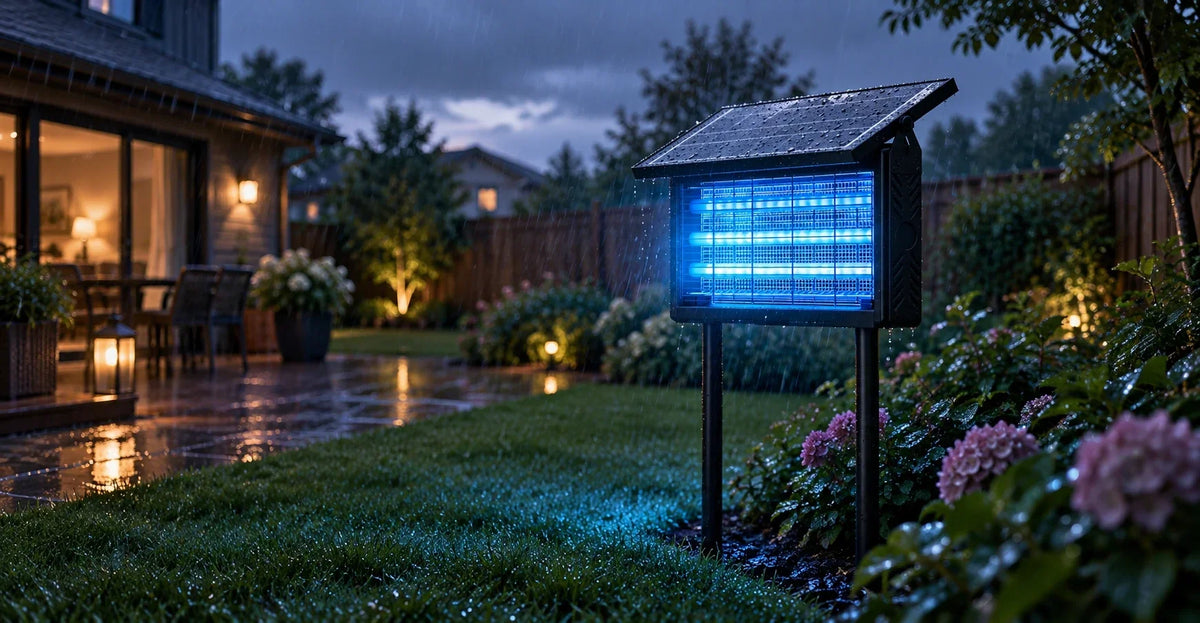
Murutoi's G8 and G8L carry an IPX5 waterproof rating, which means the housing is built to handle splashing water from any direction — rain, sprinklers, and general outdoor moisture exposure. In practical terms, that means a passing shower or a sprinkler zone nearby isn't something to panic about. It's rated for outdoor life, not just outdoor storage.
That said, IPX5 is about water resistance, not full submersion — so a unit left sitting in a deep puddle after a storm is a different situation than one that simply got rained on while hanging or staked upright as intended.
Cloudy Days: Slower Charging, Not No Charging
Solar panels don't need direct, cloudless sun to generate power — they just generate less of it under overcast skies. A string of gray days will typically mean a slower charge than a string of bright ones, but it doesn't mean the panel stops working entirely. Ambient daylight still gets converted, just less efficiently than full sun.
The practical effect is usually a shorter runtime after a cloudy stretch rather than a zapper that won't turn on at all — especially if it had a decent charge built up before the weather turned.
Building In a Buffer
If a rainy week is in the forecast, a simple habit helps: give the unit a full, sunny-day charge whenever you get the chance, rather than waiting until the charge is nearly gone. A fuller starting charge gives more buffer to coast through several dim days without a noticeable drop in evening runtime.
After the Storm Passes
Once the rain clears, a quick wipe-down of the solar panel surface is worth doing — dust, pollen, or water spots that dried on the panel can slightly reduce how much light it absorbs. Clearing that off restores full charging efficiency without any real effort.
The Bottom Line
Bad weather isn't the threat to a solar bug zapper that it might seem like at first. The waterproofing is built for exactly this kind of exposure, and cloudy-day charging is a matter of degree, not an on/off switch. A little extra sun on the first clear day is usually all it takes to catch back up.