Mosquito-Free Living Insights
Backyard BBQ Setup Guide: Where to Place Your Bug Zapper for Best Results
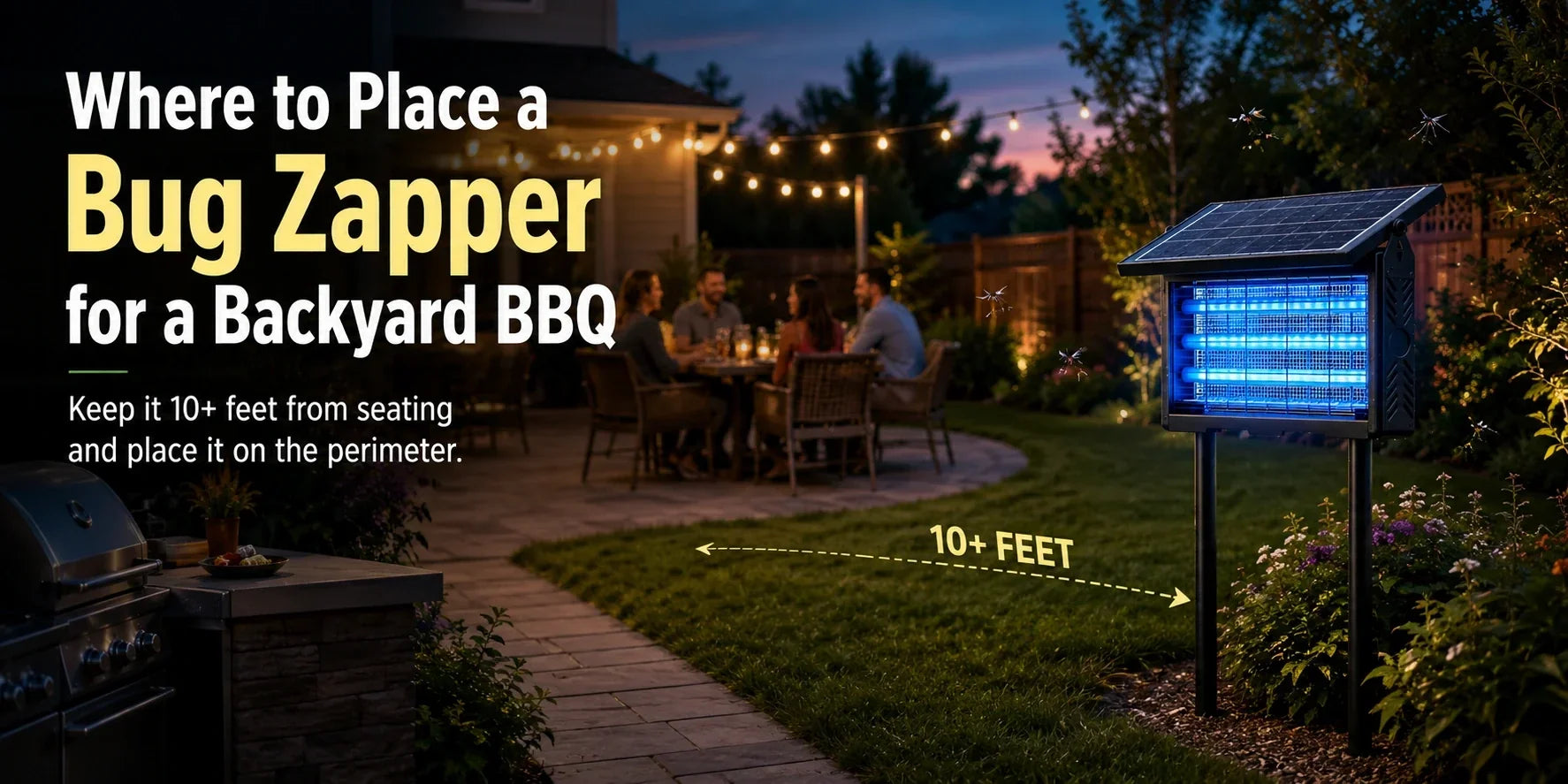
Placement affects how well a bug zapper performs at an outdoor gathering. A commonly recommended general guideline is to position it roughly 10+ feet away from your seating and dining area, at the perimeter of the space rather than the center, so it's less likely to draw insects through where your guests are sitting.
Placement can make a real difference in how a bug zapper performs at a backyard BBQ. Put it in a less ideal spot — right next to the grill, right next to the table, or tucked in a corner with poor airflow — and it may not perform as well as it could, or could even end up drawing insects toward the general area where your guests are. Here's some general guidance on setup.
A General Distance Guideline
A commonly cited rule of thumb: keep your bug zapper roughly 10 feet or more away from your seating and dining area.
Bug zappers work by luring insects toward a light source (and, on some models, additional attractants). That's the basic idea behind the light lure — but it also means a unit placed very close to your guests may draw insects through the seating area on their way to the light. Keeping some distance is generally thought to give the zapper more room to intercept insects before they reach the people and food. As with most pest-control guidance, actual results can vary based on yard layout, wind, and local insect populations, so treat this as a starting point rather than a guarantee.
General Placement Tips
1. Perimeter, not center Many households find it helpful to treat the zapper as a boundary marker rather than a centerpiece — placed at the edge of the patio, yard, or gathering space, often facing toward likely mosquito sources such as grass, garden beds, standing water, or shaded areas.
2. Consider wind direction If there's a steady breeze during your gathering, positioning the zapper slightly upwind of the seating area is a commonly suggested adjustment, since it may help direct the light's draw away from guests.
3. Some distance from the grill Smoke and heat from a grill can affect airflow around a zapper. Keeping some separation between the grill and the zapper is generally reasonable, both as a placement consideration and for basic clearance around an active cooking area.
4. Elevation can help Some guidance suggests mounting or placing a zapper at a slightly elevated position (on a stand, railing, or hook) rather than directly on the ground, since many mosquitoes fly at low-to-mid height.
5. Sun exposure for solar models For solar-powered units, placement also needs to account for daytime charging. A spot with good sun exposure for most of the day supports more consistent charging.
A Simple Setup Layout (Example)
For a typical backyard BBQ, one commonly used layout looks like:
- Seating/dining area: center of the usable space
- Grill station: to one side, away from foot traffic
- Zapper #1: toward the yard's edge or nearest likely mosquito source (garden, fence line, treeline), with some distance from seating
- Zapper #2 (optional, for larger yards): opposite perimeter point, to help cover the space from more than one direction
This is one example layout, not a fixed formula — actual best placement depends on your yard's shape, wind patterns, and where mosquitoes tend to originate.
A Few Things Worth Avoiding
- Placing it right next to the drink or food table — food and drinks are already a draw on their own, so stacking a light lure in the same spot isn't generally recommended.
- Tucking it into a fully enclosed corner — airflow can matter for how effectively scent and light cues travel, so a very boxed-in spot may limit range.
- Waiting until dusk to set it up — mosquito activity often increases in the hour or so before sunset, so having the zapper running (and, for solar models, already charged) before guests arrive is generally a good idea.
Placement is one of the more meaningful factors in how a bug zapper performs at an outdoor gathering. As a general guideline, keeping some distance (commonly cited as around 10 feet) from seating, positioning it toward the yard's perimeter facing likely mosquito sources, and setting it up before the event starts are all reasonable practices — though results can vary by location and conditions.